Science News
 American
Science News for 21 January 2015
American
Science News for 21 January 2015
Growing Human Kidneys in Rats Sparks Ethical Debate
Live Science - 21 Jan 2015 07:07 It sounds like the plot from a science fiction film: A scientist takes a kidney from a human fetus, implants it in a rat and allows the organ to grow. But researchers in a new study have done exactly that, in the hopes t...
Size of Internalized Calcium Phosphate Particles Plays a Critical Role in Cell Fate
Biomaterials Science - 21 Jan 2015 12:14
Calcium phosphate (CaP) based materials have long been popular choices for a range of medical applications including bone replacement and drug delivery. However, recent studies indicate a need for a closer look at how ce...
How Genes and Environment Conspire to Trigger Diabetes
Live Science - 21 Jan 2015 00:15 Environmental factors such as diet may alter the expression of genes to cause, and reverse diabetes, new research finds.
Alexander the Great-Era Tomb Holds Bones of 5 People
Live Science - 21 Jan 2015 22:55 A lavish Alexander the Great-era tomb found in Amphipolis, Greece, holds the skeletal remains of at least five people.
Uber's taxi data will help us understand our cities
New Scientist - 21 Jan 2015 22:30
Cities like Boston are slurping up data from private companies about how we live - and using it to improve services and transport
Developer has plans to preserve Westinghouse atom smasher
Phys.org - 21 Jan 2015 22:20
A developer has knocked over the Westinghouse atom smasher east of Pittsburgh but plans to preserve the structure no matter what happens to the property it was on.
Comet 67P/Churyumov-Gerasimenko: Rosetta's report
The Economist - 21 Jan 2015 22:03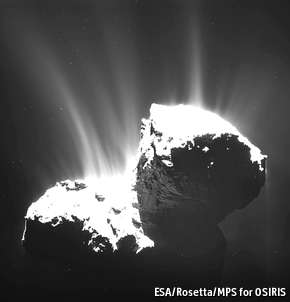 IN NOVEMBER the public's imagination was briefly caught by the adventures of a plucky little spacecraft called Philae. This craft, the pup of a mother ship known as Rosetta, made a bouncy landing onto the surface of come...
Let them eat steak: How to eat meat the healthy way
New Scientist - 21 Jan 2015 22:00
Linked to all manner of illness and an eco-villain too - meat has an image problem. But the evidence says that smart diners can welcome it back to the menu (full text available to subscribers)
Water Bounces Right Off This Super-Repellent Material
Live Science - 21 Jan 2015 21:40 Using lasers, scientists created a new material that makes water bounce straight off it. The super-repellent surface could be used for everything from preventing icing on airplane wings to creating self-cleaning latrines...
Move Over, Siri! New Software Could Make Better Personal Assistants
Live Science - 21 Jan 2015 21:15 A new software program combines your schedule and preferences with the best route to get you where you need to go.
'Nanostar' Particles Make Cancer Cells Light Up
Live Science - 21 Jan 2015 21:04 New particles that researchers call "nanostars" can enter cancer cells and then illuminate them when struck by a laser, new research shows. The technique could be used to better see the outlines of patients' tumors, rese...
Back to black: The enduring quest to portray nothing
New Scientist - 21 Jan 2015 21:00
A painting of a black square shown in Russia 100 years ago broke new ground, now revisited by an exhibition in London and a carbon nanotube take on the original
2014 Warmest Year Recorded: NASA Explains Why | Video
Live Science - 21 Jan 2015 20:57 "It's a result of human-induced global warming," says NASA Goddard Space Flight Center's Steven Pawson referring to recently released data. Pawson notes how the cold East Coast winter and El Nino event had little effect ...
Open talk about suicide in the UK might prevent it
New Scientist - 21 Jan 2015 20:06
Inspired by a programme in Detroit, a British plan aims to reduce the number of suicides to zero among people treated by the National Health Service
Closer to Self-Destruction? Doomsday Clock Could Move Tomorrow
Live Science - 21 Jan 2015 19:41 The ominous hands of the Doomsday Clock have been fixed at 5 minutes to midnight for the past three years. But they could move tomorrow.
Newswire: 21 January 2015 - INFN: A cloud for European research
Interactions - 21 Jan 2015 19:30
The INDIGO-DataCloud project, with the objective of developing a new CLOUD software platform for the scientific community, has been approved by the European Commission within the scope of Horizon 2020. 26 institutions an...
Today on New Scientist
New Scientist - 21 Jan 2015 19:30
All the latest on newscientist.com: give up on the multiverse, Haeckel's fudged embryos, Ex Machina, name that exoplanet, a personality for health and more
New method to generate arbitrary optical pulses
Phys.org - 21 Jan 2015 19:16 Scientists from the University of Southampton have developed a new technique to generate more powerful, more energy efficient and low-cost pulsed lasers.
Big Brother map spots illegal fishing in an instant
New Scientist - 21 Jan 2015 19:14
A video wall can tell when fish are stolen from the ocean in milliseconds by tracking ships and the species they are allowed to catch
Revealing secrets of atomic nuclei
Phys.org - 21 Jan 2015 19:12 Individual protons and neutrons in atomic nuclei turn out not to behave according to the predictions made by existing theoretical models. This surprising conclusion, reached by an international team of physicists includi...
Melting Glaciers Pose a Carbon Menace
Live Science - 21 Jan 2015 18:58 Melting glaciers pose another threat beyond sea level rise. They will dump massive amounts of organic carbon into the world's oceans, altering ecosystems.
Super Hydrophobic Material Makes Water Bounce Off | Video
Live Science - 21 Jan 2015 18:53 Scientists have created a laser-etched form of metal that makes water bounce off straight off it, and could be used in airplane wing coatings and keeping surfaces bacteria-free.
 Global
 Great Britain
 Indian
 South Africa